


Image: Shixart1985 / Wikimedia Commons (CC BY 2.0)
The last few weeks of the year are busy for almost every small business. Holiday sales, client deadlines and personal plans all compete for attention, and year-end admin tends to slide into January. That delay is costly. Some of the most useful financial and tax moves are only available before December 31, and records that are messy at year-end become painful during tax season.
A clear year-end routine turns a scramble into a few organized sessions. The infographic below lays out seven areas to cover, from cleaning up your books to setting goals for the new year. The sections that follow explain what to do in each area and why it matters. Rules differ by country, state and business structure, so use this as a framework and confirm specifics with your accountant.
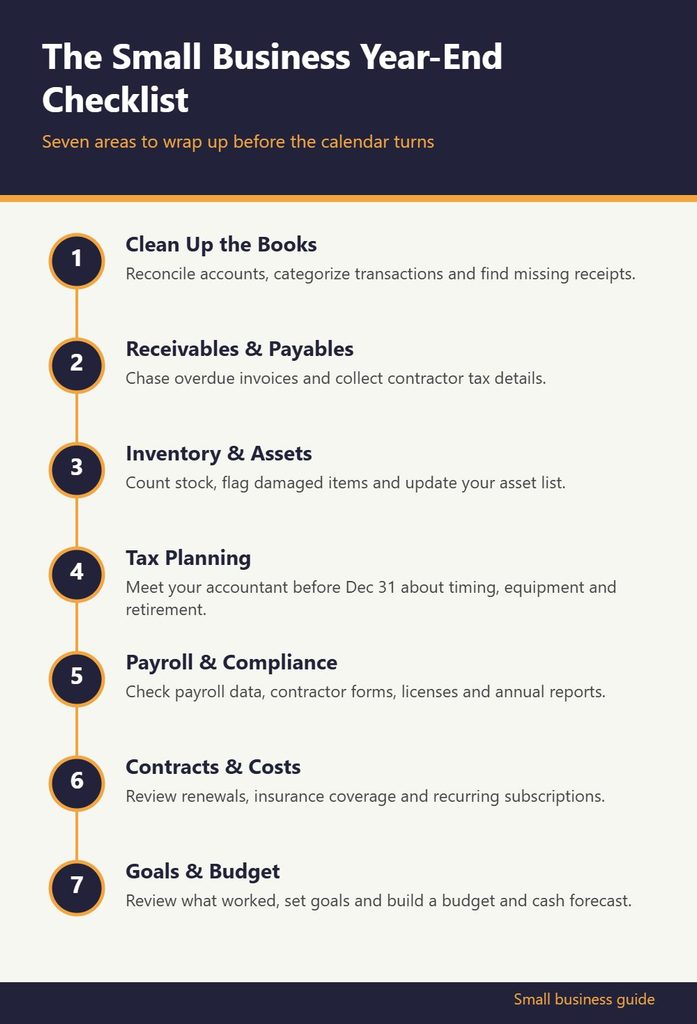
1. Reconcile and Clean Up Your Books
Everything else on this list depends on accurate numbers. Before you think about taxes or planning, make sure your accounting records match reality.
Work through these steps:
- Reconcile every bank and credit card account through the last statement available, so the balances in your software match the balances on the statements.
- Categorize uncategorized transactions. Many accounting tools hold an “uncategorized” or “ask my accountant” bucket that quietly fills during the year.
- Hunt for missing receipts, especially for larger purchases and anything you plan to deduct.
- Separate personal and business transactions. If personal expenses slipped through the business account, record them properly, often as owner draws, rather than as business expenses.
- Review loan balances against lender statements, splitting payments between principal and interest.
If the books are significantly behind, it may be worth hiring a bookkeeper for a catch-up project now rather than handing a shoebox to your tax preparer in the spring. Catch-up work done at year-end is usually cheaper and less stressful than catch-up work done against a filing deadline.
2. Review Accounts Receivable and Payable
Next, look at who owes you money and whom you owe.
On the receivable side, run an aging report from your accounting software. Follow up on overdue invoices before the holidays, when clients are often closing out their own budgets and may be willing to pay. For invoices that are truly uncollectible, talk to your accountant about whether and how to write them off; the treatment can depend on whether you report income on a cash or accrual basis.
On the payable side, confirm that every bill you owe is recorded. Make sure you have current tax identification details for any contractors you paid during the year, since many tax systems require information returns for certain contractor payments early in the new year. In the U.S., for instance, businesses typically need a Form W-9 on file for contractors in order to prepare 1099 forms. Collecting this paperwork now saves a frantic January.
3. Count Inventory and Assets
If you sell physical products, a year-end inventory count is often essential for calculating cost of goods sold and, by extension, taxable profit. Even businesses that use inventory software should do a physical count or spot-check to catch shrinkage, damage and errors.
Tips for an efficient count:
- Schedule it on a slow day or after hours.
- Use two-person teams, one counting and one recording.
- Identify obsolete or damaged stock and ask your accountant how to handle it.
- Compare the count with your system records and investigate large differences.
Service businesses should still review fixed assets: computers, equipment, vehicles and furniture. Update your asset list with anything bought or disposed of during the year, since depreciation and certain deductions depend on it.
4. Plan Your Tax Moves Before December 31
This is the area where timing matters most. Once the year closes, many options disappear. Schedule a planning meeting with your accountant in November or early December, bring your year-to-date profit and loss statement, and discuss moves like these:
- Timing income and expenses. Businesses using cash-basis accounting may be able to shift some income into the next year or pull some planned expenses into the current one. Whether this makes sense depends on whether you expect to be in a higher or lower bracket next year.
- Equipment purchases. Some tax systems allow accelerated deductions for qualifying equipment placed in service before year-end. Rules and limits change, so verify the current treatment before buying for tax reasons alone.
- Retirement contributions. Owner retirement plans can reduce taxable income, and some must be set up before year-end even if contributions can be made later.
- Estimated payments. Check whether your estimated tax payments for the year are on track to avoid penalties.
- Entity review. If profits have grown, ask whether a different business structure or tax election could make sense for next year.
Never buy something you do not need just to get a deduction. A deduction reduces taxable income by the cost of the item; it does not give you the money back. Spend only on things that serve the business.
For background reading before that meeting, GrowBizLab publishes plain-language guides on small business tax deductions, cash flow and business bank accounts, all available on its official website. Your tax authority’s own publications remain the final word on rules, but reading a practical overview first can help you arrive at your accountant’s office with better questions.
It also helps to bring a short written list to that meeting: expected revenue for the full year, any large purchases you are considering, changes in staffing, and major life events such as marriage or a new home that might affect your personal return. Owners of pass-through entities often find their business and personal tax pictures are closely linked, so a planning session that looks at both together tends to surface more options than one that looks at the business in isolation. Ask your accountant to put the agreed actions in writing, with dates, so nothing gets lost in the holiday rush.
5. Handle Payroll, Contractor and Compliance Paperwork
Year-end is when a lot of compliance tasks cluster. Missing them can lead to penalties that are entirely avoidable.
Review this list and add anything specific to your jurisdiction:
- Payroll records. Confirm employee names, addresses and identification details so year-end wage statements are accurate.
- Bonuses and benefits. Decide on any year-end bonuses and make sure they run through payroll correctly.
- Contractor forms. Gather the information needed to issue contractor information returns on time.
- Business licenses and permits. Check renewal dates for state, county and city licenses.
- Annual reports. Many states require LLCs and corporations to file annual or biennial reports with the Secretary of State, often with a fee. Look up your due date.
- Registered agent and beneficial ownership details. Confirm your contact and ownership information on file is current.
A calendar with every recurring compliance deadline for the coming year is one of the most useful documents a small business can keep. Build it now while the list is fresh.
6. Review Contracts, Insurance and Subscriptions
Year-end is a natural time to audit the agreements and recurring costs that shape your business.
Contracts. Check client agreements, vendor contracts and leases for renewal dates, auto-renewal clauses and price escalations. Decide which to renegotiate and which to let lapse. If your standard client contract has caused friction this year, have it reviewed and updated before you send it to new clients in January.
Insurance. Ask whether your coverage still fits the business. Did you hire staff, add equipment, move premises or start offering new services? Each of these can change your insurance needs. Talk to your broker about general liability, professional liability, property and, increasingly, cyber coverage.
Subscriptions. Export the last three months of card and bank transactions and list every recurring software and service charge. Cancel tools nobody uses, downgrade plans that are over-specified and consolidate overlapping products. This exercise regularly uncovers savings that more than pay for the hour it takes.
If you are rethinking your software or insurance setup, the same site’s guides to small business insurance, contracts and project management software are a reasonable starting point; go here to browse them by section.
7. Set Goals and Budget for the New Year
With clean books and a clear picture of the past year, you are in a strong position to plan the next one.
Start with a short review:
- Which products, services or clients were most profitable?
- Which took the most time relative to what they earned?
- Where did cash get tight, and why?
- What did customers ask for that you did not offer?
Then set a small number of concrete goals, such as a revenue target, a profit margin goal, a number of new clients, or a cash reserve equal to a set number of months of expenses. Build a simple monthly budget that reflects those goals and a cash flow forecast that shows when money will come in and go out.
Finally, schedule quarterly check-ins on your calendar now. A year-end review is far easier when it is the fourth review of the year rather than the first.
A Simple Year-End Timeline
To keep the workload manageable, spread it out:
- Early November: start reconciling accounts and chasing receivables.
- Mid-November: run a year-to-date profit and loss statement and book the tax planning meeting.
- Early December: make any tax-related decisions, review contracts and insurance, audit subscriptions.
- Late December: count inventory, finalize payroll items and confirm contractor details.
- Early January: close the books, issue required forms, and finalize your goals and budget.
None of these tasks is difficult on its own. The challenge is fitting them into the busiest season. Block the time on your calendar the same way you would block a client meeting, and treat it as just as important. Your future self, sitting calmly in front of a tidy set of books in February, will be grateful.