

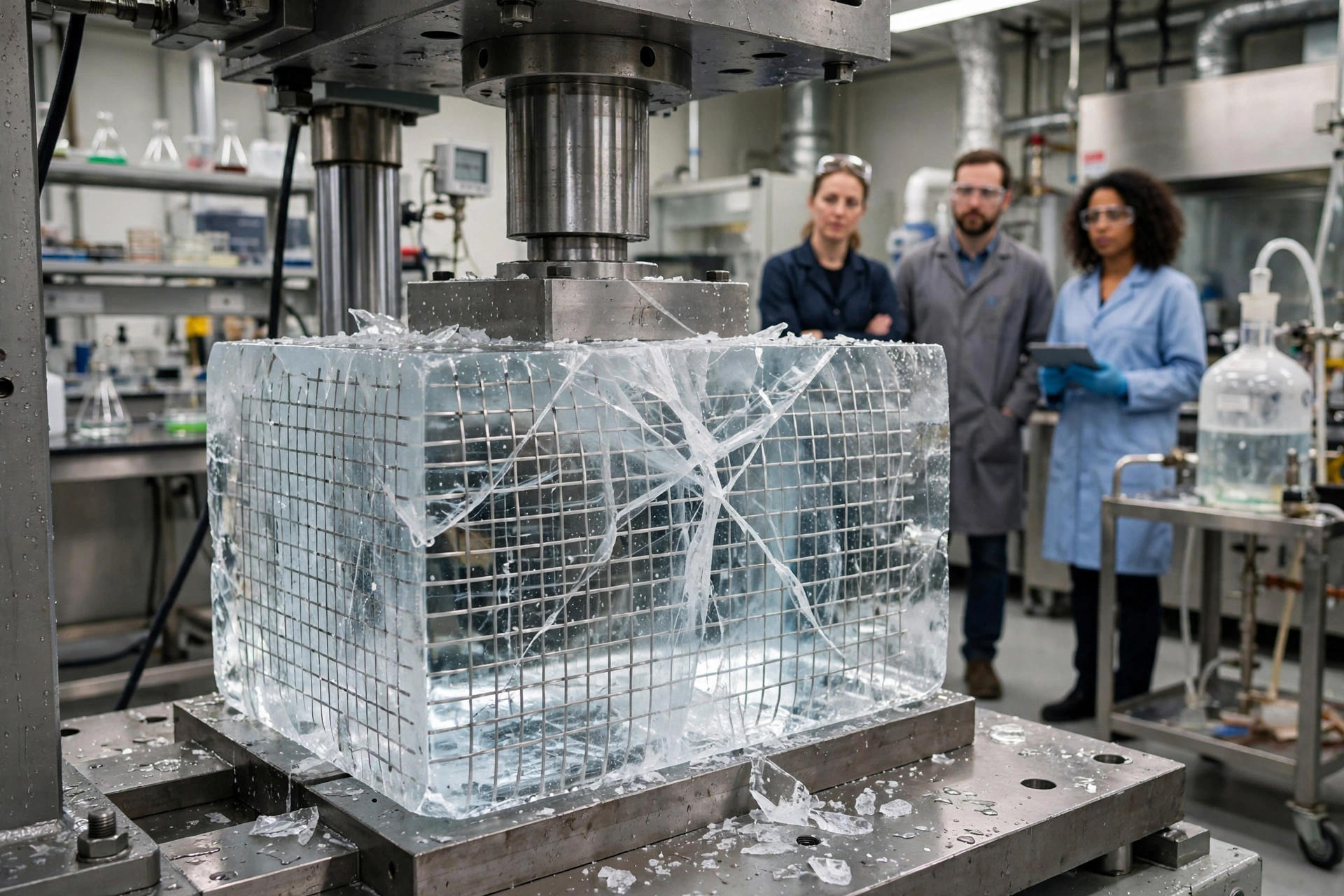
Ice is not supposed to be a serious building material. It cracks, it creeps, and above all it melts. But researchers at the Hebrew University of Jerusalem have created a engineered version they call BioPykrete that is ten times stronger than ordinary ice, absorbs around seventy times more energy before breaking, and is approaching the strength of concrete — while being made mostly of frozen water and plant material.
The work, published in Colloids and Surfaces B: Biointerfaces and reported by ScienceAlert, deliberately revives one of the Second World War’s strangest engineering ideas — and rebuilds it at the molecular level.
From wartime iceberg ships to nanocrystals
In the 1940s, British engineers experimented with Pykrete, a composite of ice and wood pulp, as a material for an unsinkable aircraft carrier. The project was abandoned as costs rose and better options appeared, but the basic insight survived: fibres mixed into ice make it far tougher than ice alone.
The new team went much smaller. Instead of wood pulp’s large, disordered fibres, they used cellulose nanocrystals — microscopic rods derived from plants that act as a strengthening scaffold and make it harder for cracks to spread through the material. The second ingredient is the clever part: a bespoke engineered protein, combining an antifreeze protein with a carbohydrate-binding module, which works as a molecular glue binding the cellulose crystals to the ice crystals around them.
Stronger — and slower to fail
The result is not just stronger ice, but ice that fails differently. Ordinary ice shatters suddenly once a crack takes hold. BioPykrete deforms gradually and absorbs far more energy before breaking, behaviour that matters enormously for any structural use, where warning signs before failure are the difference between an inconvenience and a catastrophe.
The team says the formulation can be tuned further — by optimising freezing protocols and developing new variants of the binding protein, they expect still stronger composites.
A building material for the coldest places on Earth
Nobody is proposing ice tower blocks for temperate cities. The target is construction in remote polar and sub-polar regions, where shipping in concrete and steel is expensive, carbon-intensive and sometimes impractical, but water and cold are abundant. A material whose main ingredients are ice and plant-derived cellulose could be produced on site, would carry a low carbon footprint, and is biodegradable at the end of its life.
The researchers frame it as part of a broader shift: using biotechnology to design sustainable materials for an industry that remains one of the world’s largest sources of emissions and resource use. It is the kind of materials story that sits naturally alongside other boundary-pushing technology we cover, from AI systems spreading across connected devices to the science of everyday wellbeing in our health coverage.
Still a proof of concept
Plenty stands between the laboratory and a building site. The study was a small-scale proof of concept; the team still needs to test how BioPykrete performs over long periods, under changing temperatures and loads, and to confirm exactly how cracks move through the material. Durability in real Arctic conditions — freeze-thaw cycles, wind, salt, time — is unproven.
But as a demonstration of what happens when protein engineering meets structural materials, it is striking: a wartime curiosity, rebuilt molecule by molecule, into one of the strongest forms of ice ever made.