

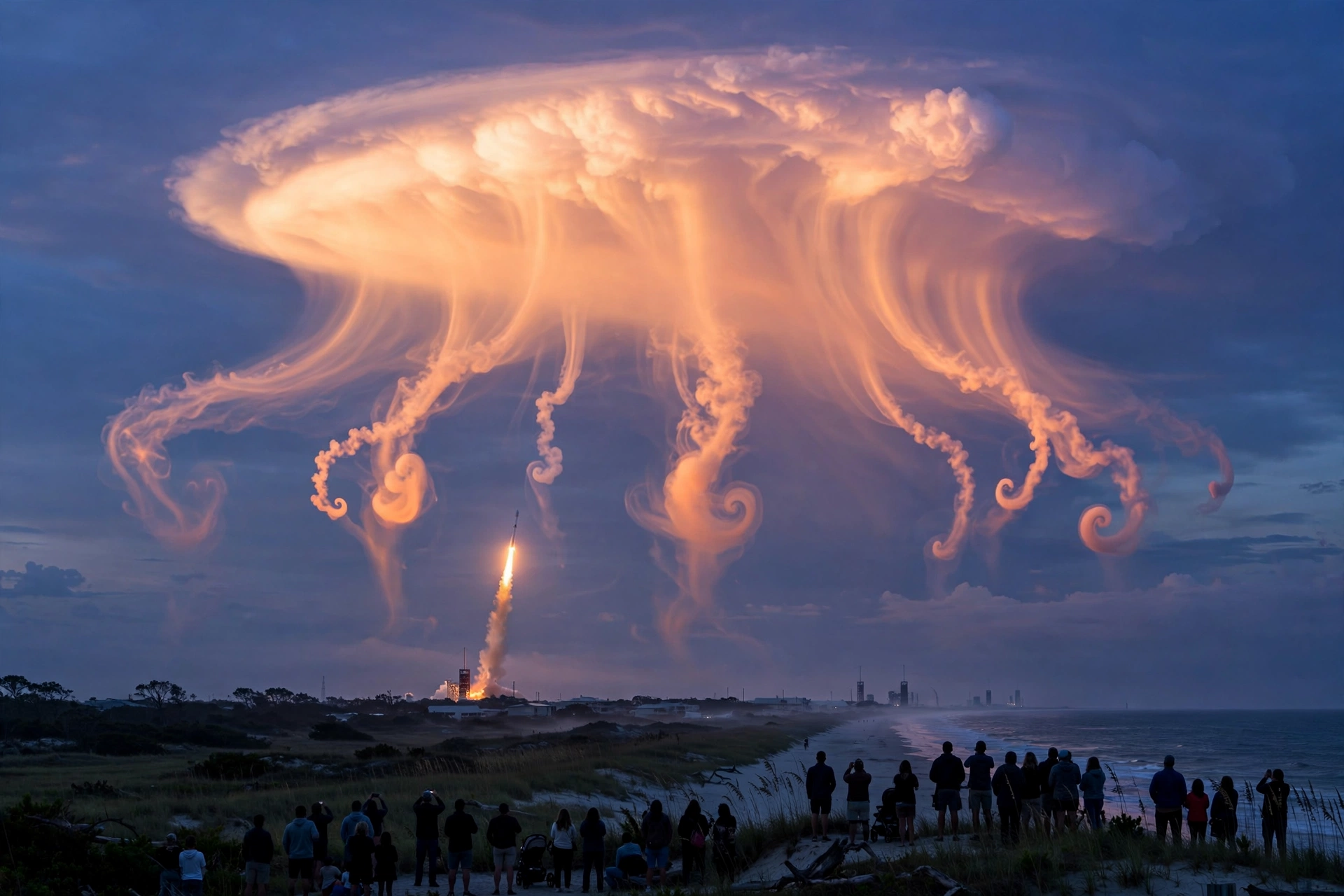
Early risers along the United States east coast were treated to an otherworldly sight this week: a glowing, jellyfish-shaped cloud drifting high in the dawn sky after a SpaceX rocket launch. Photos of the phenomenon spread quickly online, showing a luminous plume with trailing tendrils lit up against the dark blue of twilight — beautiful enough that many witnesses described it as something between a comet and a creature from the deep sea.
What Creates the Jellyfish Effect?
The spectacle is known to astronomers and launch watchers as the “twilight phenomenon,” and it is pure physics. When a rocket launches shortly before sunrise or just after sunset, the ground below is still in darkness while the upper atmosphere — tens of kilometres up — is already catching the sun’s light. The rocket’s exhaust plume expands in the thin air up there, and sunlight scattering through it makes the whole cloud glow.
As the plume spreads and twists in high-altitude winds, it takes on the bell-and-tentacles shape that gives the jellyfish comparison its accuracy. The effect has been documented after launches from Florida and California for years, but it never fails to startle people who see it for the first time, precisely because it appears in a sky that otherwise looks completely ordinary. The Guardian’s coverage of this week’s launch, including witness photographs, is available in its report on the jellyfish cloud sighting.
Why Dawn and Dusk Launches Look So Different
Timing is everything. A launch in the middle of the day produces a familiar white contrail lit evenly by the sun. A launch at night produces a bright point of light and a short trail. But in the narrow window around dawn and dusk, the geometry is perfect: the observer stands in shadow, the plume flies into sunlight, and the contrast turns expanding exhaust gas into a glowing sculpture.
Weather plays a part too. Clear skies along the coast allowed this week’s display to be seen across a wide stretch of the eastern seaboard. High, thin winds stretched the plume into its drifting, translucent form, and the slow expansion of gases in near-vacuum made the cloud appear to hang almost motionless before it faded.
A Busy Sky Is Becoming a Familiar One
There is a broader story behind the pretty pictures. Launch cadence has climbed sharply in recent years, and sights that once belonged only to communities near spaceports are now visible to millions of people who never expected to watch a rocket climb from their own street. Each dawn launch doubles as a small public astronomy lesson — a reminder of how much activity now takes place above our heads.
That activity is reshaping the upper atmosphere in ways scientists are still working to understand, from exhaust chemistry to the brightening night sky. As we reported in our coverage of the accelerating rate of global warming, the atmosphere is under pressure from many directions at once, and the growing traffic into orbit is one more factor researchers are learning to measure.
How to Catch the Next One
If you live within a few hundred kilometres of a launch site, your best chance is a liftoff scheduled in the hour before sunrise or the hour after sunset on a clear day. Step outside a few minutes after launch, look toward the coast, and give your eyes time to adjust. The plume often appears several minutes after the rocket itself has vanished, blooming slowly rather than flashing.
Photographers recommend a phone on a tripod or braced against a railing, with a slightly longer exposure to capture the faint outer edges of the cloud. But honestly, the best advice is simpler: put the phone down for the first minute and just look. Some sights earn their viral moment, and a silent, glowing jellyfish drifting through the dawn is one of them.