

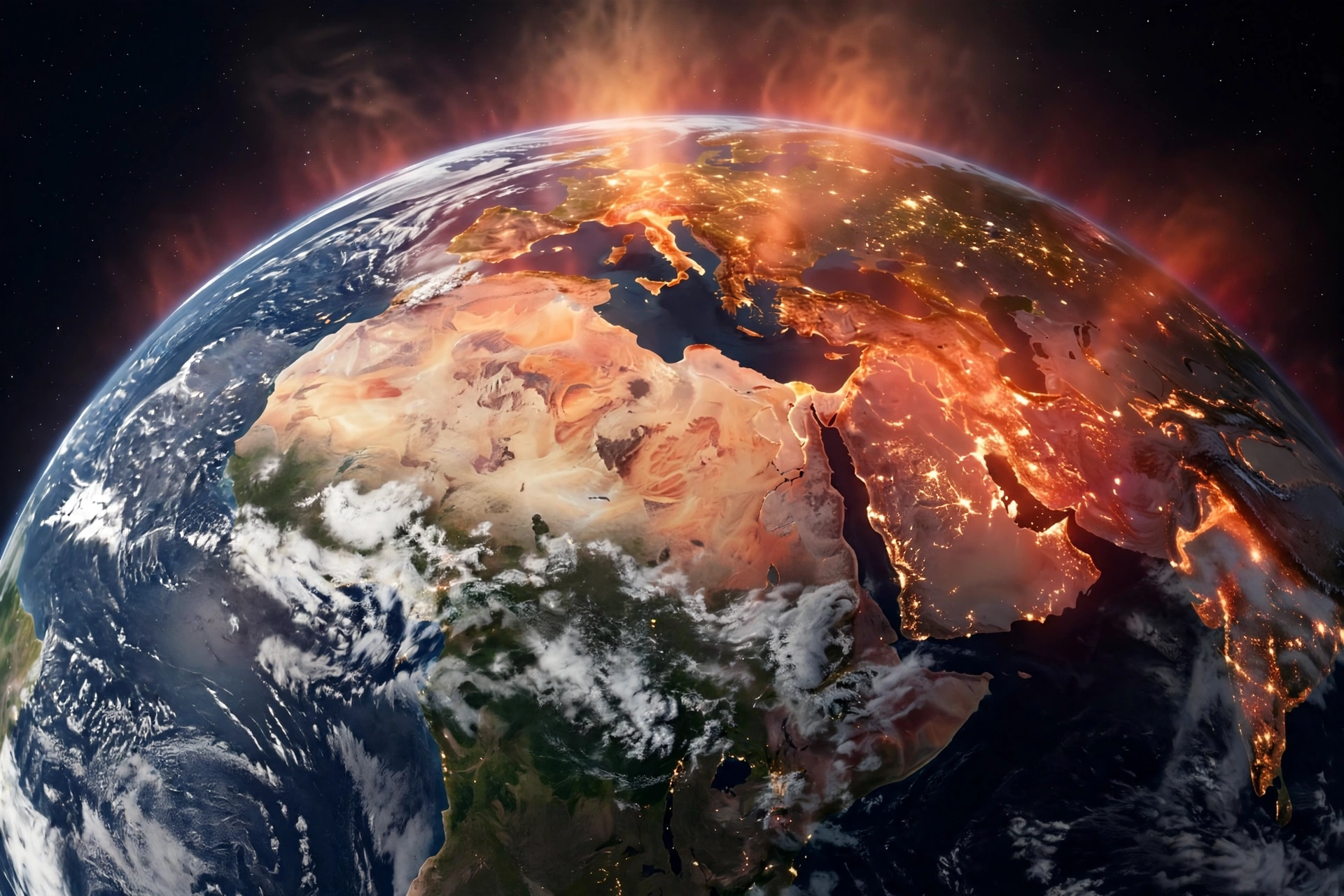
The rate of global warming has doubled in recent years, according to a new study in npj Climate and Atmospheric Science — and if the faster pace holds, the world will cross the Paris Agreement’s 1.5°C threshold by 2028, several years earlier than previous estimates of the early 2030s.
A statistically significant doubling
Qinjian Jin and Bing Pu of the University of Kansas analysed observational temperature records through 2025. They found the planet warmed at 0.40°C per decade between 2011 and 2025 — a statistically significant doubling of the 0.20°C per decade recorded across 1971–2025. Extrapolating that accelerated rate forward brings the 1.5°C crossing to 2028. The full paper is available from Nature’s npj Climate and Atmospheric Science.
The acceleration is not evenly spread. The authors attribute it mainly to intensified warming over three regions: East Asia and the North Pacific, mid-latitude Eurasia, and the South Atlantic–Antarctic sector. That regional pattern matters for impacts, because warming concentrated over populated mid-latitudes and ocean gateways drives weather extremes and ice loss faster than a uniform rise would.
The models missed it
Perhaps the most striking finding is about the tools used to plan for climate change. Across an ensemble of 26 climate models, the average simulated warming rate was only 0.29°C per decade — the models, collectively, failed to capture the observed doubling. If the observations are right, adaptation plans and carbon budgets built on model-average rates are systematically too relaxed.
Why the rate matters as much as the total
A faster rate of warming is a problem in its own right. Ecosystems, infrastructure and public-health systems adapt to gradual change far more easily than to abrupt shifts: heatwaves arrive before building codes catch up, rainfall patterns move before reservoirs are redesigned, and disease vectors expand into regions with no surveillance — one reason mosquito-borne illnesses are gaining ground in places like France.
There is an irony in the timing. Human engineering keeps producing remarkable cold-climate innovations — witness the “super ice” ten times stronger than ordinary ice — even as the climate those inventions must operate in changes faster than the plans written for it.
A narrowing window
The authors’ conclusion is blunt: the window to limit warming to 1.5°C is narrower than assumed, and holding it would require rapid, substantial cuts in greenhouse-gas emissions. The 2028 date is an extrapolation, not a prophecy — the rate of warming responds to the rate of emissions, and this decade’s choices still bend the curve. But at 0.40°C a decade rather than 0.20°C, the arithmetic of delay has changed: every year of flat emissions now buys a measurably hotter planet, measurably sooner.